Comparison
Power Dialer vs Predictive Dialer: Choosing by Team Size and List Quality
Power dialer vs predictive dialer is decided by two numbers you already know: how many people call at once, and how many of the people on your list pick up. The Auto Dialer is the power option.
Power dialer vs predictive dialer difference
Power dialer vs predictive dialer is really a question about statistics. A power dialer needs none: it rings one number per rep, and the rep hears every ring. A predictive dialer depends on them. It pools all agents on a campaign, measures the answer rate, and launches extra calls on the bet that most will not connect. Bets like that only work across a crowd. With 40 agents, an unlucky minute is smoothed out by the next one; with 3, one guess that goes wrong can leave a third of the minute's answered calls with nobody on the line. List quality pulls the same way. When most people answer, as with fresh enquiries or booked callbacks, there are few rings to save and predictive gains shrink. Regulators fix the price of errors: Canada does not let a predictive dialing device's abandonment rate go above 5 percent in any calendar month. The Auto Dialer sits on the power side, on each caller's phone.
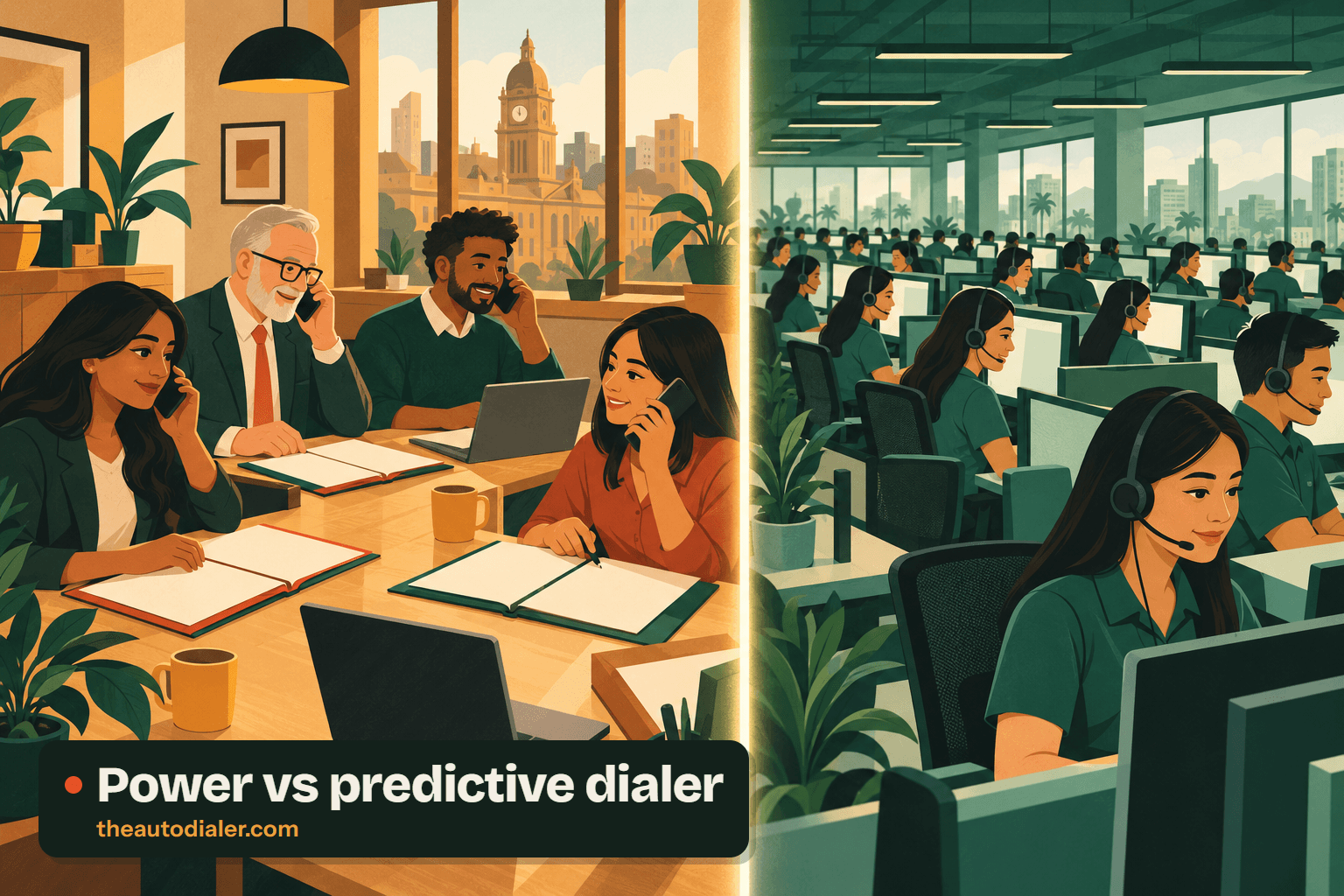
Power dialer vs predictive dialer by team size
| Situation | Power dialer | Predictive dialer |
|---|---|---|
| One rep | Works from day one | Cannot forecast with one agent |
| Three to ten reps | Each works an assigned queue | Forecast errors are a big share of answers |
| Twenty-five or more agents on one campaign | Agents spend much of the hour hearing rings | Pacing starts to pay for itself |
| Warm list: enquiries, renewals, callbacks | High answer rate, little to save | Little to gain, risk of dropping a keen buyer |
| Cold list with a low answer rate | Rings eat most of the hour | Where it was designed to shine |
| Rep needs notes before speaking | Record shows while it rings | Record arrives with the answer |
| Market strict on silent calls | Nothing to manage | Abandon rate must be tracked and capped |
Power dialer vs predictive dialer list quality
Answer rate decides how much a predictive engine can save. If 1 call in 2 is answered, a power dialer rep hears on average one ring-out per conversation; the saving from dialing ahead is small. If 1 call in 10 is answered, the rep hears about nine ring-outs per conversation, and dialing ahead removes most of that waiting. So a predictive dialer is worth testing only when two things are true together: the list is cold and the floor is large. If either is false, the power option is simpler, cheaper to run and kinder to the people you call. If the vendor pages you are reading just say "auto dialer", first check which branch they mean using auto dialer vs power dialer. A deeper look at the forecasting side is under how predictive pacing works, and the one-line side under power dialing on a phone. The same trade-off between waiting and dropping calls is weighed in predictive dialer vs progressive dialer, and the multi-line option for single reps in power dialer vs parallel dialer. Every mode appears side by side on types of dialers.
Power dialer vs predictive dialer example
Both teams are invented, with round numbers, to show the arithmetic; neither is a customer.
A mortgage desk in Leeds has 4 advisers and 200 applicants waiting on document calls. Most applicants expect the call, so say 6 in 10 answer. Each adviser works a queue of 50, hears a ring-out on about 20 of them, and spends the rest of the time talking. A predictive engine would have almost nothing to save and would risk leaving an applicant on a silent line during a stressful purchase. Power dialing is the fit; the sector is covered under mortgage dialer. Across the world, a 40-seat centre in Cebu works a bought list where 1 in 10 answers. In a power mode each agent would sit through roughly nine ring-outs per conversation. There, a predictive platform, tuned under the abandonment ceiling, earns its cost.
Power dialer vs predictive dialer limits
The Auto Dialer does not offer the predictive column at all. It has no shared pool, no pacing ratio and no internet lines; each phone dials its own queue. Teams in the second scenario above should buy a cloud contact centre platform, and the fit for smaller centres is discussed under call centre dialers. Anyone running predictive mode should also understand the abandoned call rate and, when calling Canada, the CRTC dialer rules.
The Canadian and UK points are general information, not legal advice.
Power dialer vs predictive dialer FAQ
11 questions, answered
How does a power dialer work?
A power dialer takes the next number from the list the moment a rep finishes a call, after any pause you set, and rings it on the rep’s single line. The rep hears the ringing, so whoever answers is greeted straight away.
Is a power dialer better than a predictive dialer?
It depends on headcount and list. With a few reps and warm leads, power dialing wins: no abandoned calls and no tuning. With dozens of agents on a cold list where most dials ring out, predictive pacing keeps agents talking for more of the hour.
Which power dialer vs predictive dialer option suits a team under ten?
The Auto Dialer suits that size: a power-style dialer on each person’s phone, each caller with a personal queue the owner fills, and a shared view of every call made. Under ten agents, a forecasting engine misjudges often enough that its errors become a large share of answered calls.
Is The Auto Dialer power or predictive?
The Auto Dialer is a power dialer. It rings one lead per phone, from the phone’s SIM, and waits for that call to finish before ringing the next. It has no pacing ratio, no forecast and no answering machine detection.
Can one system run both power and predictive modes?
Many cloud contact centre platforms offer both and let a supervisor pick per campaign, for example power mode for callbacks and predictive for a large cold list. A phone-based dialer offers only the power mode, because a SIM carries one call.
Which is cheaper, a power dialer or a predictive dialer?
It depends on the vendor, but the cost shapes differ. Predictive dialing spends telephony minutes on surplus dials and usually needs a platform, lines and someone to tune it. A power dialer can run on existing phones and mobile plans, as The Auto Dialer does, with a licence per user.
Does a predictive dialer make more calls than a power dialer?
Per agent, usually yes on cold lists, since agents spend less of the hour hearing rings. On warm lists where most people pick up, the gap narrows because there are few ring-outs to skip, while the risk of dropping an expected caller remains.
Can a power dialer cause abandoned calls?
In the one-line sense, no: the caller is already listening when the number rings, so nobody answers to silence. Certain contact centre vendors apply the label to dialing a fixed two or three lines per agent, and that variant can abandon calls, so check what a vendor means.
When should a team switch from power to predictive dialing?
When two things hold together: many agents work one campaign, and the list is cold enough that most dials ring out. Add a supervisor to watch the abandon rate and lines with spare capacity. If any of those is missing, stay with power dialing.
Do power dialers need answering machine detection?
No. A rep who reaches a recorded greeting simply hangs up, losing a few seconds. Predictive systems rely on detection because no agent is listening at the moment of answer. The Auto Dialer has none; its ring cap and shortest-call setting stop mailbox pickups from closing leads.
What is the abandoned call limit for predictive dialers in Canada?
Under the CRTC’s telemarketing rules, a predictive dialing device’s abandonment rate must not exceed 5 percent in a calendar month, and an answered call with no live telemarketer inside two seconds counts as abandoned. One-line power dialing sidesteps the measure. This is general information, not legal advice.
A small team does not need a forecast
Give each caller a queue and a phone that dials it. Ask for a team trial.